
By Purple Essence • 05/03/2025
Estimated Reading Time: 4 Minutes
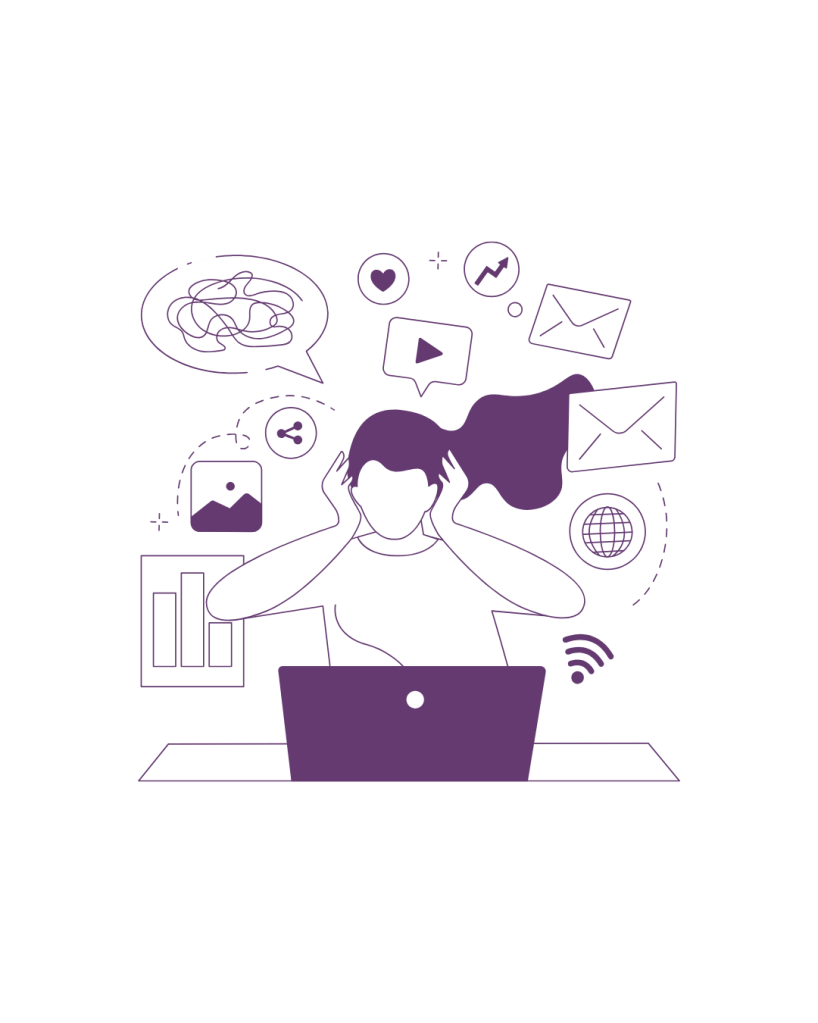
We live in a world where notifications, emails, and constant pings are the norm. While technology makes our lives easier, it can also lead to digital overload—a state of stress, distraction, and fatigue from never fully unplugging. Research shows that setting healthy tech boundaries can boost mental well-being, improve focus, and enhance real-life relationships (Barber & Santuzzi, 2015). Below, we’ll explore simple, practical ways to cut back on screen time and reclaim your peace.
1. The Hidden Costs of Digital Overload
Increased Stress & Anxiety
• Constant notifications can put you in a “hyper-alert” state, triggering the body’s stress response.
• Studies link “telepressure” (the urge to respond immediately to messages) to higher burnout (Barber & Santuzzi, 2015).
Reduced Focus & Productivity
• Switching between apps or checking social media repeatedly fragments attention, making it harder to concentrate on one task.
• The result? Lower productivity and more time spent catching up on undone tasks (Mark et al., 2016).
Less Real-Life Connection
• Excessive screen time can replace face-to-face interactions, leading to loneliness and weaker social bonds (Twenge et al., 2018).
2. Practical Steps to Reduce Screen Time
a. Set App Timers
• Most smartphones have built-in features (like “Screen Time” on iOS or “Digital Wellbeing” on Android) that let you set daily limits on specific apps.
• By capping your usage, you’re forced to consciously decide whether extra scrolling is worth it.
b. Create Device-Free Zones
• Keep your phone out of bedrooms or dining areas. This encourages better sleep and more mindful mealtimes.
• If needed, use an old-fashioned alarm clock instead of your phone.
c. Batch Your Notifications
• Turn off unnecessary alerts and schedule set times to check messages or emails.
• This approach prevents the “always-on” feeling and helps you focus on one task at a time.
d. Try a “Digital Detox” Day
• Pick one day a week—or even a few hours—to unplug.
• Use that time for hobbies, outdoor walks, reading, or catching up with friends face-to-face.
e. Unfollow & Unsubscribe
• Social feeds can be cluttered with negativity or irrelevant content.
• Periodically unfollow accounts that don’t add value or joy. Similarly, unsubscribe from emails you never open.
f. Replace Scrolling with Mindful Activities
• Swap your late-night Netflix binge for 10 minutes of journaling or a short bedtime story.
• If you feel the urge to pick up your phone, try breathing exercises, a quick stretch, or a cup of tea instead.
3. The Benefits of Cutting Back
Better Sleep Quality
• Reducing screen time before bed helps your body produce melatonin, the hormone that regulates sleep (Chang et al., 2015).
Improved Mental Health
• Studies link lower social media use to decreased rates of depression and loneliness (Hunt et al., 2018).
More Time & Focus
• With fewer distractions, you can devote your energy to meaningful tasks—or simply enjoy a quiet moment.
4. Addressing Common Excuses
a. “But I need my phone for work!”
That’s fine—boundaries can be set around your working hours. After you’re done, log off work-related apps to prevent after-hours stress.
b. “I don’t have time to unplug.”
Start small. Even 15 minutes of device-free time can be refreshing. Build up as you see the benefits.
c. “I’ll miss out on important updates.”
Realistically, most notifications aren’t urgent. If something truly urgent happens, people can call you directly.
Digital overload is a modern challenge—but it’s one you can tackle with simple, mindful strategies. By setting app timers, creating device-free zones, and unsubscribing from digital noise, you’ll find more focus, peace, and genuine connection in your daily life. Remember: it’s not about ditching tech entirely; it’s about using it intentionally.
Which tip are you most excited to try? Let me know in the comments, and here’s to reclaiming our time in a hyperconnected world.
References
• Barber, L. K., & Santuzzi, A. M. (2015). Please respond ASAP: Workplace telepressure and employee recovery. Journal of Occupational Health Psychology, 20(2), 172–189.
• Chang, A. M., Aeschbach, D., Duffy, J. F., & Czeisler, C. A. (2015). Evening use of light-emitting eReaders negatively affects sleep, circadian timing, and next-morning alertness. Proceedings of the National Academy of Sciences, 112(4), 1232–1237.
• Hunt, M. G., Marx, R., Lipson, C., & Young, J. (2018). No more FOMO: Limiting social media decreases loneliness and depression. Journal of Social and Clinical Psychology, 37(10), 751–768.
• Mark, G., Iqbal, S. T., Czerwinski, M., & Johns, P. (2016). Focused, aroused, but so distractible: A temporal perspective on multitasking and communications. Proceedings of the 2016 CHI Conference on Human Factors in Computing Systems.
• Twenge, J. M., Joiner, T. E., Rogers, M. L., & Martin, G. N. (2018). Increases in depressive symptoms, suicide-related outcomes, and suicide rates among US adolescents after 2010 and links to increased new media screen time. Clinical Psychological Science, 6(1), 3–17.
 Purple Essence
Leave a comment